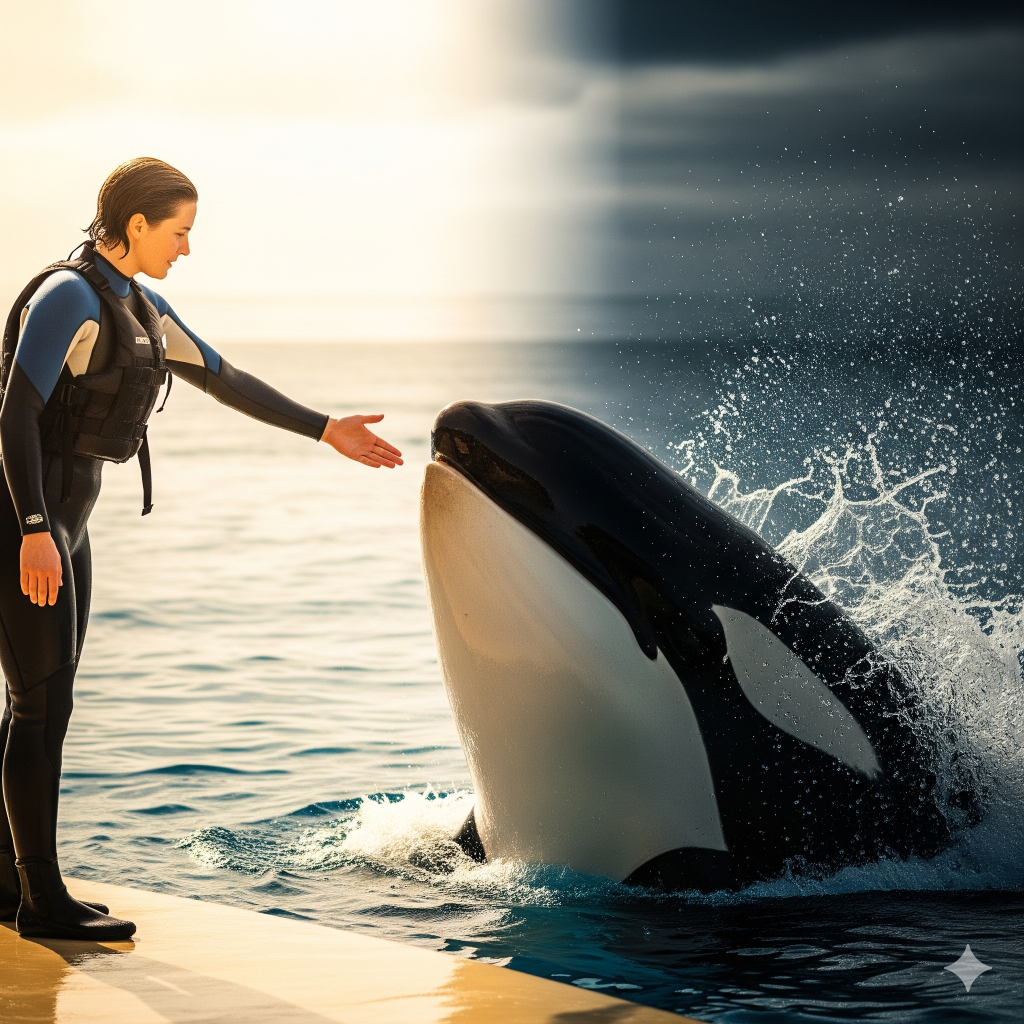

Killer Whale Encounters – Drama, Danger & Bond
From a Powerful Connection to a Shocking Tragedy
In the world of marine parks and oceanariums, few relationships appear as awe-inspiring as the bond between a trainer and a killer whale. These massive, intelligent creatures — often called orcas — are known for their power, precision, and complex social behavior. When paired with a dedicated human trainer, the result can look almost magical: synchronized performances, gentle interactions, and what seems like genuine trust.
But behind the spectacle lies a far more complicated story — one that, in some cases, has ended in heartbreak.
The Illusion of Perfect Harmony
For years, audiences have watched in amazement as trainers swam beside towering dorsal fins, balanced on rostrums, and performed carefully choreographed routines with animals weighing several tons. The connection often appeared affectionate and mutual. Trainers spoke of deep bonds, describing the whales as intelligent partners rather than performers.
From the outside, it looked like love. It looked unbreakable.
And for a time, it may have felt that way.
But orcas are not domesticated animals. They are apex predators with complex emotional and social systems that scientists are still striving to fully understand. In the wild, they live in tight-knit pods, communicate through intricate vocalizations, and roam vast ocean territories. In captivity, their environment — no matter how carefully managed — is drastically different from their natural world.
When Bond Turns to Tension
In one widely discussed tragedy, a once-strong bond between a female trainer and a notoriously aggressive orca deteriorated in ways few could have predicted.
Reports suggested that the whale’s behavior had become increasingly unpredictable. Subtle warning signs — changes in mood, agitation, resistance during routines — may have been present, though difficult to interpret in real time. Trainers are trained to read body language, but with animals of this size and strength, even a small shift can have enormous consequences.
Then came the moment that stunned the marine entertainment world.
What began as a routine interaction ended in disaster. The very animal that once performed gracefully alongside its trainer became the source of unimaginable loss.
The details were shocking not only because of the outcome, but because of the emotional history between them. How could such a powerful bond collapse so suddenly?
Understanding the Complexity
Experts point to several possible contributing factors: stress, confinement, disrupted social structures, and the psychological impact of captivity. Orcas are highly intelligent mammals with advanced cognitive and emotional capacities. In the wild, they swim up to 100 miles a day. In tanks, their movement is limited. In the ocean, they live among family pods for life. In marine facilities, social groupings are often artificial and subject to change.
These factors can create tension beneath the surface — tension that may not always be visible during public performances.
The tragedy forced a global conversation about the ethics of keeping large marine mammals in captivity. Documentaries, investigations, and public debates followed. For many, the event marked a turning point in how society viewed marine entertainment.
Drama, Danger, and the Human Cost
“Killer Whale Encounters – Drama, Danger & Bond” is more than a story about a single incident. It is about the fragile line between admiration and risk. It is about the emotional investment trainers make — dedicating years of their lives to working closely with animals that command both beauty and danger.
It is also about the reality that no matter how strong a bond may seem, these animals remain powerful, instinct-driven beings.
There is drama in the performances.
There is danger in the proximity.
And there is undeniable bond — complicated, profound, and sometimes misunderstood.
A Sobering Reflection
This tragedy serves as a sobering reminder that nature cannot be fully controlled, only respected. The connection between humans and wild animals can be extraordinary, but it must always be approached with humility.
What appeared to be a loving partnership evolved into a heartbreaking event that changed lives and reshaped an industry.
In the end, the story is not simply about aggression or betrayal. It is about complexity — about the limits of human understanding, the immense power of the natural world, and the responsibility that comes with bringing that world into captivity.
Sometimes the most dramatic encounters are not just about danger — but about the lessons they leave behind.